The End of the Uncanny Valley: How Robots are Learning to Smile
For decades, the concept of the Uncanny Valley has haunted the field of robotics. This psychological phenomenon describes the sense of unease or even revulsion that humans feel when they encounter a humanoid figure that looks almost, but not quite, human. While we are perfectly comfortable with a stylized cartoon or a clearly mechanical robot, the closer a machine gets to mimicking a real person, the more our brains tend to reject it. One of the primary culprits behind this “creepy” feeling is the mouth. In human communication, lip movements are incredibly nuanced, synchronized with sound down to the millisecond, and filled with micro-expressions that signal emotion. Until recently, robot mouths were clunky, mistimed, and fundamentally unnatural. However, researchers at Columbia Engineering have unveiled a breakthrough that could change human-robot interaction forever. By allowing a robot to learn lip movements through self-observation and human imitation, scientists are finally bridging the gap between mechanical speech and lifelike expression.
Understanding the Uncanny Valley: Why Robot Faces Creep Us Out
To understand the importance of the recent Columbia University breakthrough, we must first dive into the psychology of humanoid robot design. The term “Uncanny Valley” was first coined by Japanese roboticist Masahiro Mori in 1970. He observed that as a robot’s appearance is made more human, our emotional response to the robot becomes increasingly positive and empathetic, until a point is reached where the response suddenly turns to strong repulsion. This dip in the graph—the valley—is where the “creepiness” resides. The reason for this is deeply rooted in our evolutionary biology. Human beings are social creatures who have evolved highly specialized neural pathways for facial recognition and the interpretation of non-verbal communication.
When we look at a face, our brains are processing thousands of tiny data points simultaneously. We look for symmetry, skin texture, eye movement, and most importantly, the synchronization of speech with lip movement. In a natural human conversation, the lips don’t just move up and down; they twist, stretch, and compress to form specific shapes known as “visemes” that correspond to the “phonemes” of spoken language. When a robot attempts to speak but the lip-syncing technology is off by even a fraction of a second, or if the mouth shape doesn’t match the sound perfectly, our brains register a “prediction error.” This error triggers an alarm in the amygdala, the part of the brain associated with fear and the “fight or flight” response. We perceive the robot not as a friendly assistant, but as something “wrong,” “dead,” or “diseased.”
Historically, programmers tried to solve this by manually coding every single mouth movement. They would spend hundreds of hours mapping specific motor positions to specific sounds. However, this approach lacked the fluidity of organic movement. It resulted in stiff, jerky motions that failed to capture the subtle transitions between words. To make robots truly relatable, engineers needed a system that wasn’t just programmed, but one that could learn and adapt—much like a human infant learns to speak by watching its parents. This shift from manual coding to machine learning algorithms marks the turning point in modern social robotics.
The Columbia Breakthrough: Mirrors, Cameras, and Machine Learning
The researchers at Columbia Engineering’s Creative Machines Lab, led by Professor Hod Lipson, have taken a radical new approach to this problem. Instead of telling the robot how to move its face, they built a robot that could figure it out for itself. The robot, often referred to in these studies as “EVA,” is equipped with a soft, flexible skin and multiple actuators (tiny motors) beneath the surface that simulate human facial muscles. The breakthrough lies in the robot’s use of visual feedback and a process known as “self-modeling.”
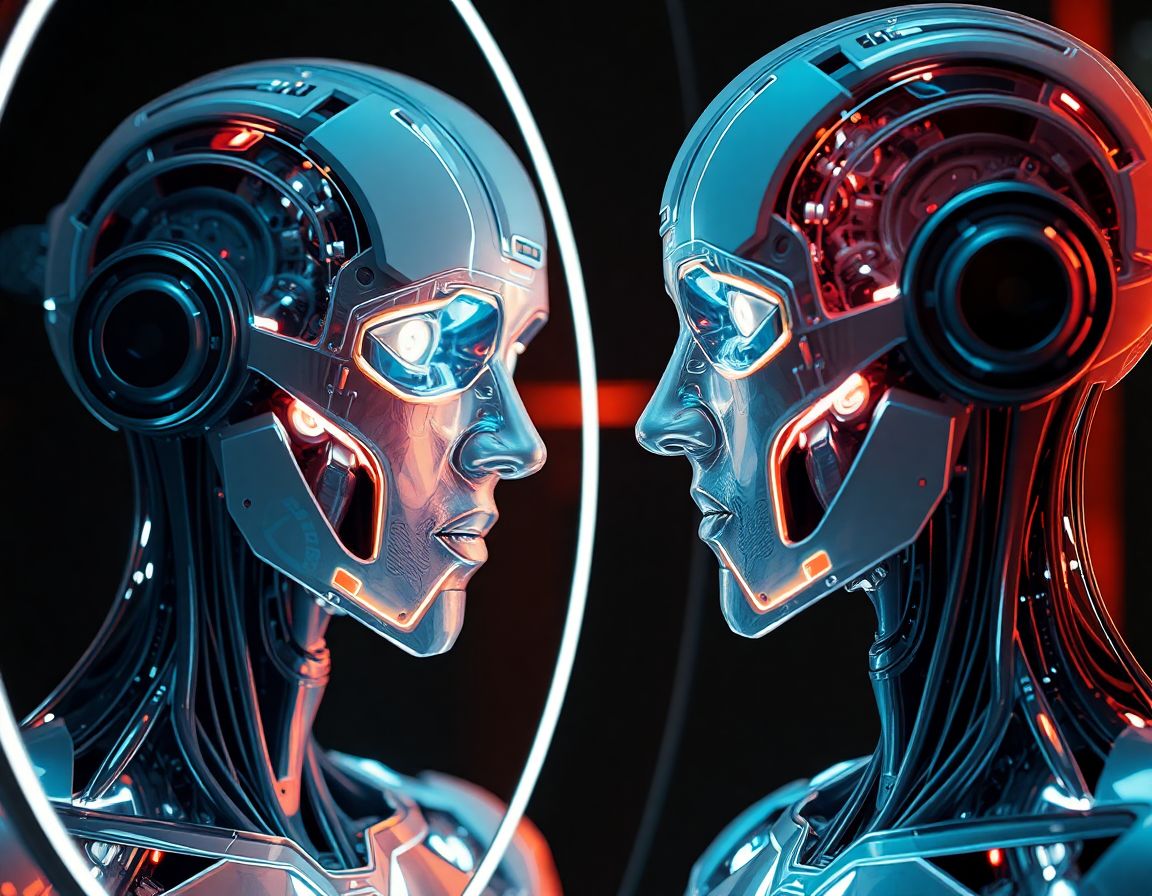
In the experiment, the robot was placed in front of a mirror, where it began a process similar to human “babbling.” It would move its facial motors at random and observe the resulting changes in its appearance via an internal camera. This allowed the robot to create a mental map of its own face—a cognitive computing model of how its mechanical “muscles” translated into visual expressions. By watching its own reflection, the robot learned the relationship between its motor commands and the visual output. It essentially gained a sense of self-awareness regarding its own physical form.
Following this self-observation phase, the robot was shown videos of human speakers. Using advanced neural networks, the robot compared the human lip movements to its own “mirror” data. It began to realize that to make the “O” sound, it needed to activate specific actuators in a way that mimicked the human in the video. This process of learning by observation mirrors how human children develop motor skills. By using artificial intelligence to bridge the gap between human video data and its own mechanical capabilities, the robot developed a degree of motion synthesis that manual programming could never achieve. The result is a robot that doesn’t just “flap” its mouth when sound comes out, but one that shapes its lips with a fluid, human-like grace that significantly reduces the “creep factor.”
Bridging the Communication Gap: The Science of Lip Synchronization
Why are the lips so vital to our perception of intelligence and empathy? In human-robot interaction, the mouth serves as the focal point of our attention. Studies in linguistics and psychology have shown that when people listen to someone speak in a noisy environment, they subconsciously rely on lip-reading to fill in the gaps. This is known as the “McGurk Effect,” where what we see can actually change what we hear. If a robot’s lips are not perfectly synchronized, it doesn’t just look creepy—it becomes harder to understand. This creates a cognitive load on the human user, making the interaction feel exhausting rather than natural.
The Columbia team’s lip-syncing technology addresses this by ensuring that the robot’s physical movements are tied to the underlying intent of the speech. Because the robot learned through machine learning algorithms, it can handle the “co-articulation” of speech. Co-articulation is the way our mouth starts forming the shape of the next sound while we are still finishing the current one. For example, when you say “spoon,” your lips are already rounding for the “oo” sound while you are still pronouncing the “s.” This fluidity is what makes human speech look natural. By observing thousands of human examples, the Columbia robot can now predict these transitions, resulting in a performance that feels organic rather than robotic.
Furthermore, this technology allows for the integration of non-verbal cues. A smile isn’t just a mouth movement; it involves the cheeks, the eyes, and a specific timing that reflects genuine emotion. By learning the “logic” of a human face through observation, these robots can begin to mimic the micro-expressions that signal empathy, humor, or concern. This is a massive leap forward for social robotics. We are moving away from machines that simply perform tasks and toward machines that can reside in our social spaces. According to research published in Nature, the ability of a machine to exhibit human-like facial dynamics is a key factor in building long-term trust between humans and AI systems.
From Lab to Living Room: The Future of Social Robots
The implications of this Columbia University research extend far beyond the laboratory. As we look toward a future where humanoid robots are integrated into our daily lives, the ability to communicate without causing discomfort is paramount. Think about the sectors where these robots will likely debut: healthcare, elderly care, and customer service. In a hospital setting, a robot that looks “creepy” or “uncanny” could increase a patient’s stress levels, whereas a robot with a warm, realistic smile and perfectly synced speech could provide comfort and clear communication.
In the realm of elderly care, “companion robots” are being designed to alleviate loneliness. For an elderly person with hearing loss, being able to clearly “read” a robot’s lips is not just a luxury; it is a necessity for effective communication. If the robot can mimic the comforting facial expressions of a human caregiver, the psychological benefits are multiplied. This breakthrough also has massive potential for the “metaverse” and digital avatars. The same artificial intelligence models used to drive a physical robot’s face can be used to animate digital characters, making virtual meetings and social interactions feel significantly more lifelike.
We are currently witnessing the birth of a new era in human-robot interaction. We are moving past the “tool” phase of robotics—where machines were merely vacuum cleaners or assembly line arms—and into the “companion” phase. To be successful, these companions must master the subtle art of human expression. As Professor Lipson and his team continue to refine these neural networks, we can expect robots to become even more expressive, eventually losing their “creepy” reputation entirely. For more information on the technical specifics of this study, visit the official Columbia Engineering website.
Frequently Asked Questions
1. Why do robot faces feel creepy to most people?
This is due to the Uncanny Valley effect. When a robot looks almost human but has small “errors” in its movement or appearance, our brains perceive it as unsettling or lifelike in a “wrong” way, triggering a fear response.
2. How did the Columbia robot learn to move its lips?
The robot used a process called “self-modeling.” It watched its own reflection in a mirror to learn how its motors changed its face, and then it used machine learning algorithms to mimic the lip movements of humans in videos.
3. Can these robots actually feel emotions?
No, the robots are not “feeling” emotions. They are using artificial intelligence to mimic the physical signs of emotion (like smiling or syncing lips) to make human users feel more comfortable and improve communication.
4. Will this technology make robots look 100% human?
While we are getting closer, the goal of this research is primarily to improve non-verbal communication and synchronization. Achieving a 100% human look involves many other factors like skin texture, eye moisture, and micro-movements.
5. Where will we see these non-creepy robots first?
We are likely to see them first in social robotics roles, such as receptionists, healthcare assistants for the elderly, and interactive educational tools for children, where human-like interaction is essential.
Conclusion
The transition from “creepy” to “companionable” is one of the final hurdles in the history of robotics. By teaching machines to observe themselves and learn from human behavior, Columbia engineers have unlocked a more intuitive way for AI to exist in our world. This breakthrough in lip-syncing technology and motion synthesis does more than just fix a technical glitch; it paves the way for a future where robots can provide genuine emotional support and seamless communication. As we continue to refine the humanoid robot design, the “Uncanny Valley” will likely become a relic of the past, replaced by a new era of technology that feels as natural and approachable as a conversation with a friend.